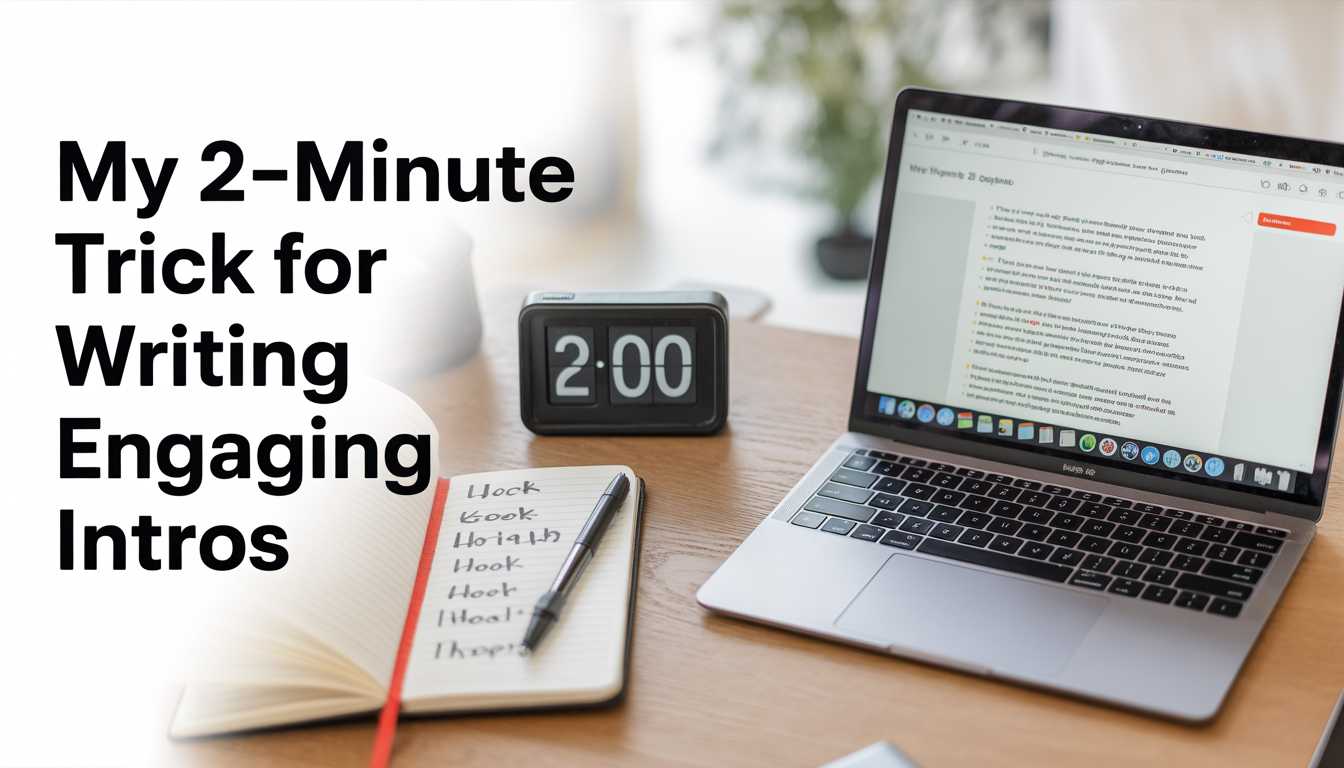
I used to stare at my computer screen for so long that I actually started to see shapes in the white space. It was like cloud watching, but much more depressing because I had a deadline. I would write one sentence, delete it, write another, and then consider moving to a desert island where there is no internet. Writing Engaging Intros felt like trying to fold a fitted sheet, it was messy, confusing, and made me want to cry. Then, I found a little trick that changed everything, and it only takes two minutes.
The Day the Cursor Won:
I remember it was a Tuesday. I had my coffee, my favorite socks on, and a big idea for a new post about Blogging. But every time I typed a word, it felt wrong. My brain was like a frozen computer. I spent three hours staring at that blinking line. It felt like the cursor was mocking me, just blinking and saying, “You have nothing to say, do you?”
This is the biggest problem in Content Writing. We think we need to be perfect right away. We think the first sentence has to be a work of art. But that pressure is what stops us from being creative. I was so worried about being “professional” that I forgot how to be human. When I finally figured out my 2-minute trick, it felt like someone had turned the lights on in a dark room.
Why Your Intro is the Most Important Part:
If you want to grow your Blog Traffic, you have to care about the first few sentences. Think about it like a first date. If someone shows up and starts talking about their bug collection for twenty minutes without taking a breath, you probably won’t go on a second date. Your intro is your first impression.
Google cares about this too. They look at something called “dwell time.” This is a fancy way of saying they watch how long people stay on your page. If people read your intro and leave right away, Google thinks your blog is boring. But if you have Engaging Intros, people stay, and Google starts to rank you higher. It is all about the User Experience.
The 2-Minute Trick Explained:
So, what is the trick? It is so simple that you might laugh. I call it the “Fast Talker” method. When I am stuck, I set a timer on my phone for exactly two minutes. During those two minutes, I am not allowed to stop typing. I have to write exactly how I would talk to my best friend at a coffee shop.
I don’t worry about spelling, I don’t worry about grammar, and I definitely don’t worry about being fancy. I just tell the story. For example, if I am writing about SEO Tips, I might spend those two minutes writing about how I used to think SEO was a type of soup.
The goal is to get the “human” part of your brain working. When the timer goes off, I usually have a paragraph that is a little bit messy, but very real. That messiness is where the magic happens. It makes you sound like a person, not a robot. And in the world of Blogging, being a person is your greatest strength.
Breaking the Rules of Formal Writing:
When I was in school, my teachers told me to never use the word “I” and to always be very serious. That is terrible advice for Blogging. If you want to connect with people, you have to break those rules.
I started writing in the first person, sharing my own failures and silly mistakes. I found that the more I admitted I didn’t know what I was doing, the more people wanted to read my work. People don’t want a lecture, they want a conversation. Using this 2-minute trick helps you get into that conversational mood quickly. It helps you find your unique voice in a sea of boring Content Writing.
The Psychology of “The Hook”:
Why does this trick work? Because it focuses on “The Hook.” In Blogging, a hook is something that grabs the reader by the shirt and says, “Hey, listen to this!”
There are a few ways to hook someone during your two-minute sprint:
- Share a secret.
- Tell a joke.
- Ask a question that everyone is thinking, but nobody is saying.
- Start in the middle of a disaster.
When I use my timer, I usually end up doing one of these naturally. My brain stops trying to be perfect and starts trying to be interesting. This is the key to Engaging Intros. You have to be more interesting than the 500 other tabs your reader has open.
How This Trick Helps Your SEO:
You might be wondering how a messy, two-minute writing sprint helps your Search Engine Optimization. It is actually quite simple. When you write naturally, you use words that people actually type into Google.
I don’t have to try to force my Primary Keywords into the text because they just show up. If I am talking about my life as a writer, I am naturally going to talk about Blogging and Writing Hacks.
Also, when your intro is fun to read, people scroll down. When they scroll down, they see your ads, they click your links, and they stay on your site. All of these things tell Google that you are an authority. This is a big part of the EEAT rules, which stand for Experience, Expertise, Authoritativeness, and Trustworthiness. By sharing your real story, you are showing your experience.
The Problem With AI Writing:
A lot of people are using AI to write their blogs now. I tried it once, and it was like eating a cardboard sandwich. It looked like food, but there was no flavor. AI can’t tell a story about the time you spilled coffee on your keyboard while trying to write an intro. It can’t feel the frustration of a blinking cursor.
To be a successful Professional Content Writer, you have to give your readers something an AI can’t. You have to give them your soul. This 2-minute trick is like a shortcut to your soul. It gets past all the boring, logical stuff and lets the real you come out to play. That is how you win at Blogging in the modern world.
Making it Easy to Read:
One thing I always keep in mind is the “5th Grade Rule.” I want my grandma to understand my blog, and I want a kid to understand it too. I use short sentences and simple words.
I also use a lot of commas instead of those long dashes that look like little sticks. Commas make the writing feel more like a breath. They make it feel like a person is talking to you, pausing every now and then to take a sip of water. This makes your Engaging Intros feel much friendlier and more welcoming.
What to Do After the Two Minutes:
Once the timer goes off, I don’t just leave it exactly as it is. I spend maybe one more minute cleaning it up. I fix the biggest spelling mistakes and make sure the transition to the next part of the blog makes sense.
But I try not to clean it too much. If you polish a rock too much, it just becomes a boring marble. I want my writing to have a little bit of texture. I want it to feel like it was written by a human who has a life and a personality. This is the “Secret Sauce” of High-Quality Content.
Dealing With Writer’s Block:
Even with this trick, some days are harder than others. Sometimes I set the timer, and I just write “I don’t know what to say” over and over again. And you know what? That is okay!
Usually, by the end of the two minutes of writing “I don’t know,” my brain gets bored and finally says something interesting. It is like priming a pump. You have to get the dirty water out before the clean water starts to flow. This is a huge lesson in Creative Writing. You have to permit yourself to be bad so that you can eventually be good.
The Power of Empathy:
When I write my intros, I try to think about exactly how my reader is feeling. Are they tired? Are they stressed? Are they looking for an answer to a problem?
If I am writing for other people in the Blogging niche, I know they are probably feeling a bit overwhelmed. So, I start my intro by acknowledging that. I say, “I know your brain feels like mush right now.” This creates an instant bond. It shows that I am on their side. Empathy is a superpower in Content Marketing. It builds trust faster than any fancy keyword ever could.
Testing Your Intros:
I like to play a game with my intros. I read them out loud. If I run out of breath before I finish a sentence, the sentence is too long. If I feel bored while reading it, the reader will definitely feel bored.
I also ask myself, “If I saw this on a social media post, would I click ‘Read More’?” If the answer is no, I go back to my 2-minute trick and try again. Sometimes it takes two or three tries to get it right, but since each try only takes two minutes, I don’t feel like I am wasting my time. This is one of my favorite Writing Hacks.
The Connection Between Intros and Headlines:
Your intro and your headline are like a team. The headline makes a promise, and the intro starts to fulfill that promise. If your headline says “My 2-Minute Trick for Writing Engaging Intros,” your intro better mention that trick pretty fast.
If you make people wait too long, they feel cheated. I always try to make sure my Primary Keywords from the title appear in the first few sentences. This is good for the reader, and it is great for SEO Optimization. It tells the search engine that you are actually talking about what you said you would talk about.
Using Visuals in Your Mind:
When I am doing my 2-minute sprint, I try to see a movie in my head. I don’t just write about “writing,” I write about the crumbs on my desk, the light coming through the window, and the way my neck hurts from leaning over.
These small details make the story feel real. They help with User Engagement because they paint a picture. Even if your blog is about something technical, you can still use these “mental pictures” to make your intro pop.
Why You Should Avoid Generic Openings:
We have all seen those blogs that start with, “In today’s fast-paced world…” or “Dictionary.com defines blogging as…”
Please, for the love of all that is holy, do not do that. Those are the most boring sentences in the history of the world. They are the opposite of Engaging Intros. They tell the reader that you have nothing original to say. My 2-minute trick helps you avoid this because nobody actually talks like that in real life. If you wouldn’t say it while eating a taco, don’t write it in your blog.
The “Slippery Slope” Effect:
The goal of a good intro is to create a “slippery slope.” You want the first sentence to make them want to read the second sentence. Then the second sentence makes them want to read the third.
Before they know it, they have slid all the way down to the bottom of your post. This is how you get people to read 4000+ words. You don’t ask them to read the whole thing at once. You just ask them to read the next sentence. This is the true art of Digital Storytelling.
My Experience With Different Niches:
I have used this trick for everything. I have written about gardening, crypto, cooking, and even rocket science. No matter how “serious” the topic is, people still want to be entertained.
In the Blogging niche, people are often looking for quick wins. So, I make sure my intro feels fast and energetic. In a more sensitive niche, like health, I might make my 2-minute sprint a bit gentler and quieter. You can change the “vibe” of your trick just by changing your mood before you start the timer.
How to Stay Consistent:
The best part about this trick is that it makes writing less scary. I used to dread starting a new post. Now, I just tell myself, “I only have to do two minutes of work.”
Once those two minutes are done, I usually feel so good that I want to keep going. It is a great way to build a Writing Habit. Consistency is the secret to success on the internet. If you can show up every day and write something human, you will eventually win.
Final Thoughts on Personal Branding:
Your intro is a big part of your personal brand. It tells people who you are and what you stand for. If you are funny, be funny. If you are serious, be serious. But whatever you do, be real.
My 2-minute trick is just a way to peel back the layers of “professionalism” and show the world the real person behind the screen. That is what people connect with. That is what makes people subscribe to your newsletter and follow you on social media. It is not about being the best writer, it is about being the most “you” writer.
A Table for Your Intro Strategy:
| Method | How it Works | Why it Wins |
| The 2-Minute Sprint | Type without stopping for 120 seconds. | It kills the inner critic and finds your voice. |
| The Coffee Shop Test | Read it like you are talking to a friend. | It ensures you sound human and relatable. |
| The 5th Grade Rule | Use simple words and short sentences. | It makes your content accessible to everyone. |
| The Hook Search | Find one “shocking” or “funny” line. | It stops people from clicking away. |
Building Authority with Every Word:
When you use my trick, you aren’t just making things up. You are sharing your lived experience. This is what Google looks for when they talk about EEAT. They want to see that the person writing the blog actually knows what they are talking about because they have lived it.
I am not a professor of writing. I am a guy who has spent thousands of hours in front of a keyboard, making mistakes and learning from them. When I share those mistakes in my Engaging Intros, I am building authority. I am showing that I am a real expert in the world of Blogging.
The Role of Humor:
Don’t be afraid to be a little bit silly. Life is serious enough as it is. If you can make someone smile in the first ten seconds of reading your blog, they are going to like you.
Humor is a great way to lower people’s defenses. It makes them more open to your message. When I do my 2-minute sprint, I often find myself writing things that make me chuckle. I keep those things in! If it made me laugh, there is a good chance it will make someone else laugh, too. That is a huge part of Content Engagement.
What if the Trick Fails?
Sometimes, you might finish your two minutes and look at the screen and think, “Wow, that is garbage.” That is okay! Just do it again.
It is only two minutes. You haven’t lost a whole afternoon. You have just spent two minutes cleaning out your brain. Usually, the second or third “sprint” is the one that sticks. This is much better than spending three hours staring at a blank page. It keeps your energy high and your spirit positive.
The Long-Term Benefits:
Since I started using this trick, my Blogging business has grown so much. My bounce rate is lower, my comments are higher, and I actually enjoy my job more.
I no longer feel that heavy weight in my chest when I sit down to write. I know that I am just two minutes away from a great intro. This confidence spreads to the rest of the blog. If you start strong, you usually finish strong. It is all about that initial momentum.
The Science of Simplicity:
There is actually a lot of science that says simple writing is more persuasive. When people can understand you easily, they are more likely to believe you.
When you use complex words and long sentences, people’s brains have to work harder. When the brain works too hard, it gets tired and cranky. By using my 2-minute trick and the 5th-grade rule, you are making it easy for people to say “yes” to your ideas. This is the heart of Effective Communication.
Looking Forward:
The world of Content Writing is always changing. We have new tools, new rules from Google, and new platforms every week. But one thing never changes: people love a good story.
Whether you are writing about Blogging, technology, or your favorite kind of cheese, the goal is always the same. You want to connect. You want to be heard. My 2-minute trick is the best way I know to make that connection happen every single time.
Conclusion:
So, next time you are stuck, don’t panic. Just set a timer, be yourself, and write like your hair is on fire. You will be amazed at what comes out. Writing Engaging Intros doesn’t have to be a nightmare. It can actually be the most fun part of your day. Now, go give it a try and see how it feels.
FAQs:
1. Does the 2-minute trick work for serious business blogs?
Yes, even business people prefer to read things that sound like a real person wrote them.
2. What if I am a very slow typer?
The speed doesn’t matter as much as the fact that you do not stop moving your fingers.
3. Do I have to use a physical timer?
You can use your phone or even a kitchen timer, but having a countdown really helps with focus.
4. Can I use this trick for the middle of my blog, too?
Absolutely, it is a great way to push through any part of the writing process where you feel stuck.
5. Is it okay to use slang in my intros?
If your audience uses that slang, then yes, it makes you sound much more authentic and relatable.
6. How do I know if my intro is simple enough for a 5th grader?
Read it to yourself, and if you see any “fancy” words that you wouldn’t use at a park, change them.