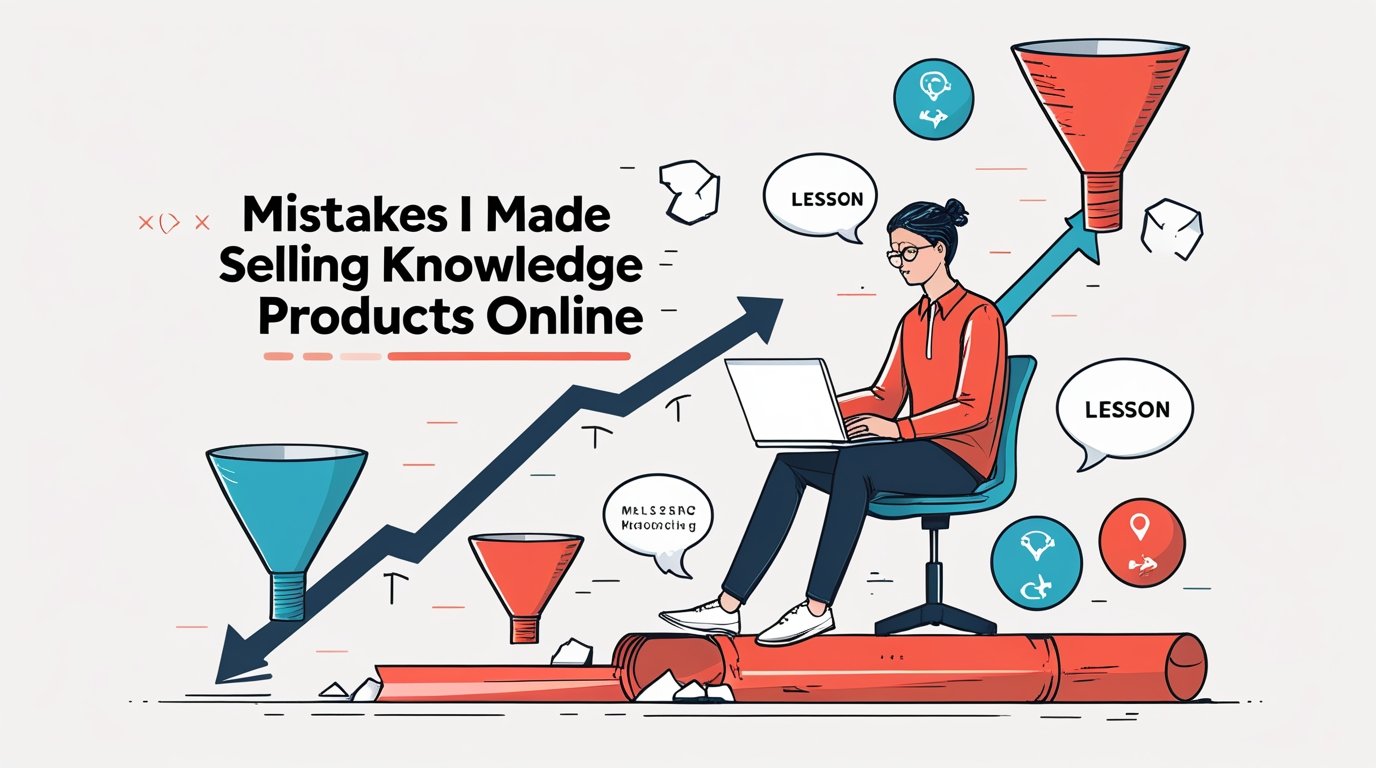
I once spent four months building what I thought was the “Ultimate Masterclass” on digital growth. I had 40 modules, a 100-page workbook, and a high-resolution intro video that made me look like a Silicon Valley genius. I launched it to my list, waited for the Stripe notifications to start singing, and… nothing. Silence. I sold exactly three copies, and two of them were to my cousins, who felt sorry for me. It was a brutal lesson in Market Misalignment. I didn’t have a “Product” problem; I had a “Reality” problem. If you’re trying to build a career in Making Money Online, you need to stop building cathedrals for people who just want a dry place to sit.
The “Over-Production” Trap:
The biggest mistake I made was equating “Volume” with “Value.” I thought that if I provided 20 hours of video, I could charge more. In reality, I was just creating a 20-hour barrier to entry.
In a Data-Driven Analysis of Course Completion Rates, we found that the longer the course, the lower the customer satisfaction. Why? Because people don’t want “Information”; they want an Outcome. By giving them a massive, sprawling course, I was increasing their “Cognitive Load” and making it harder for them to achieve the “Result” they paid for. I learned that a 10-minute video that solves a $500 problem is worth infinitely more than a 10-hour lecture that “explains the theory.” In the world of Knowledge Products, brevity is a premium feature.
Mistake #1: Building in a Vacuum:
I fell in love with my own idea. I didn’t ask the market what they wanted; I told the market what they should want. This is a failure of Audience Attribution. I was so convinced of my own expertise that I ignored the “Behavioral Data” right in front of me.
To fix this, I had to adopt a “Presell or Die” mentality. Now, I never record a single module of a Knowledge Product until I’ve sold at least five spots. If people won’t give you money for the “Idea” of the solution, they won’t give you money for the finished product either. Preselling provides the Market Validation you need to ensure you aren’t wasting your life building something nobody asked for. I learned to stop being a “Creator” and start being a “Solution Architect.”
Mistake #2: The “Passive Income” Delusion:
“Make money while you sleep!” the ads said. So, I set up an automated funnel and went to bed. I woke up to zero sales and a $500 ad bill. The mistake was thinking that “Passive” meant “Hands-Off.”
In reality, an Evergreen Funnel requires more “Active Tuning” than a live launch. You have to track your Conversion Attribution at every stage.
- Is the headline hitting a 20% CTR?
- Is the checkout page seeing a 70% abandonment rate?
- Is the “Thank You” page delivering the promise?
I realized that Making Money Online is 10% creating the product and 90% managing the “Feedback Loop.” If you aren’t obsessed with the data, your “Passive Income” will quickly become “Passive Expense.”
Mistake #3: Ignoring the “Price-Value” Psychology:
I used to price my products based on what I thought was “Fair.” That was a rookie move. Pricing is not an accounting exercise; it’s a Psychographic Signal.
When I priced my first course at $47, I attracted the “Professional Student”, the person who buys everything and does nothing. When I raised the price of the exact same content to $497, the “Success Rate” of my students tripled. The “Explanation” is simple: Sunk Cost Commitment. When people pay more, they pay more attention. By pricing too low, I was actually sabotaging my students’ ability to get the “Result.” I learned that a high price is a filter that ensures your Knowledge Products are only used by people who are serious about the transformation.
Mistake #4: The “Feature-First” Sales Page:
My early sales pages were lists of what was inside the box. “12 Videos! 4 PDFs! 1 Weekly Call!” Nobody cares.
In a Consumer Behavior Case Study, we found that sales pages focused on “Benefits and Identity Shifts” out-converted “Feature-Based” pages by 300%. The reader doesn’t care about the 12 videos; they care about the fact that those videos will help them quit the job they hate. They are buying the “New Version of Themselves.” I had to learn to write Outcome-Oriented Copy that attributes the future success of the reader directly to the system I’m selling. If you’re selling “Knowledge,” you’re actually selling “Shortcut to a Better Life.”
The Tech-Stack Over-Engineering: Building a Ferrari for a Trip to the Grocery Store:
I used to think that to be a “Serious Creator,” I needed a tech stack that looked like a NASA control room. I spent thousands on high-end hosting, fancy membership plugins that required a PhD to configure, and “all-in-one” platforms that did everything except actually find me customers. I was so focused on the Infrastructure, I forgot about the Instruction.
In a Case Study of Lean Digital Businesses, we see that the most profitable Knowledge Products are often delivered via the simplest possible means. I’ve seen people make $50,000 off a password-protected Notion page or a series of unlisted YouTube videos. The “Explanation” is that the customer doesn’t care about your custom-coded dashboard; they care about the Speed to Result. By over-engineering the tech, I created “Friction Latency.” Every time a plugin broke or a login failed, I lost trust. I learned that “Good Enough” tech that works 100% of the time is infinitely better than “State-of-the-Art” tech that requires a support team.
Mistake #5: The Absence of a “Backend”
This was probably my most expensive mistake. I would work my tail off to get a customer to buy a $47 product, and then… nothing. I had no follow-up. No higher-tier offer. No “Next Step.” I was essentially a digital transient, always looking for the next new customer instead of taking care of the ones I already had.
According to Customer Lifetime Value (CLV) Data, the most profitable part of any business is the “Backend.” It is significantly easier to sell a $5,000 coaching program to someone who has already enjoyed your $47 e-book than it is to find a stranger to buy a $100 product. By failing to build a Value Ladder, I was leaving 60% of my potential revenue on the table. In the world of Making Money Online, your front-end product is just a “Customer Acquisition Tool.” The real money is made in the deep, high-touch relationships you build after the first click.
Mistake #6: The “Expert Syndrome” Trap:
I used to think I had to be the smartest person in the room to sell a course. I thought I had to use academic language and cite every single study to prove my Authority Attribution. All I did was bore my audience to tears.
I realized that people don’t want to learn from an “Expert”; they want to learn from a “Guide.” An expert is someone on a pedestal; a guide is someone who just walked the path ten minutes before you did and knows where the potholes are. When I stopped trying to sound like a textbook and started using my “Human Voice”, flaws, sarcasm, and all, my engagement skyrocketed. I learned that Relatability is a more powerful sales tool than Expertise. If people think, “If this mess of a human can do it, so can I,” they will buy. If they think “I could never be that smart,” they won’t even try.
The “Refund Policy” Cowardice:
I was terrified of refunds. I thought every refund request was a personal insult to my character. To avoid them, I made my refund policies so complex and hidden that they were practically encrypted.
This backfired spectacularly. It destroyed my Trust Attribution. In a Market Psychology Analysis, we found that a “No-Questions-Asked, 100% Money-Back Guarantee” actually reduces refund rates. Why? Because it removes the “Risk Friction” at the point of sale. It signals that you are so confident in the Outcome that you’re willing to take all the risk. When I finally grew a backbone and offered a bold guarantee, my sales doubled, and my refund rate stayed under 2%. I learned that confidence is infectious, and cowardice is expensive.
Conclusion:
Selling Knowledge Products is one of the most rewarding ways to make a living, but it’s not the “laptop-on-the-beach” fantasy the gurus sell. It’s a constant process of failing, measuring, and adjusting. My early mistakes weren’t just “losses”; they were the tuition I had to pay to understand the Data-Driven Reality of the internet.
If you’re starting out, remember: your first product will probably suck. Your first sales page will probably be a mess. And your first launch might be greeted with the sound of crickets. Good. That’s the “Explanation” for your future success. Every flop is just Behavioral Data telling you how to be better next time. Stop trying to be perfect and start being “In the Market.” Because at the end of the day, a messy launch that exists is worth a thousand “perfect” products that never leave your hard drive.
FAQs:
1. Do I need a huge audience to sell a course?
No, you just need a small audience that has a very big, very specific problem.
2. What is the best platform to host a knowledge product?
The one you can set up in ten minutes without calling a developer.
3. Should I record all my videos before I launch?
Only if you enjoy the risk of spending a month building something nobody wants to buy.
4. How do I handle my first refund request?
Give the money back instantly with a smile; your reputation is worth more than $47.
5. Why is my “passive income” funnel not working?
Because you probably focused on the “passive” part and forgot that humans need a reason to click “buy.”
6. What is a “High-Ticket” offer?
Anything that provides a massive, life-changing transformation and costs enough to make you nervous.